
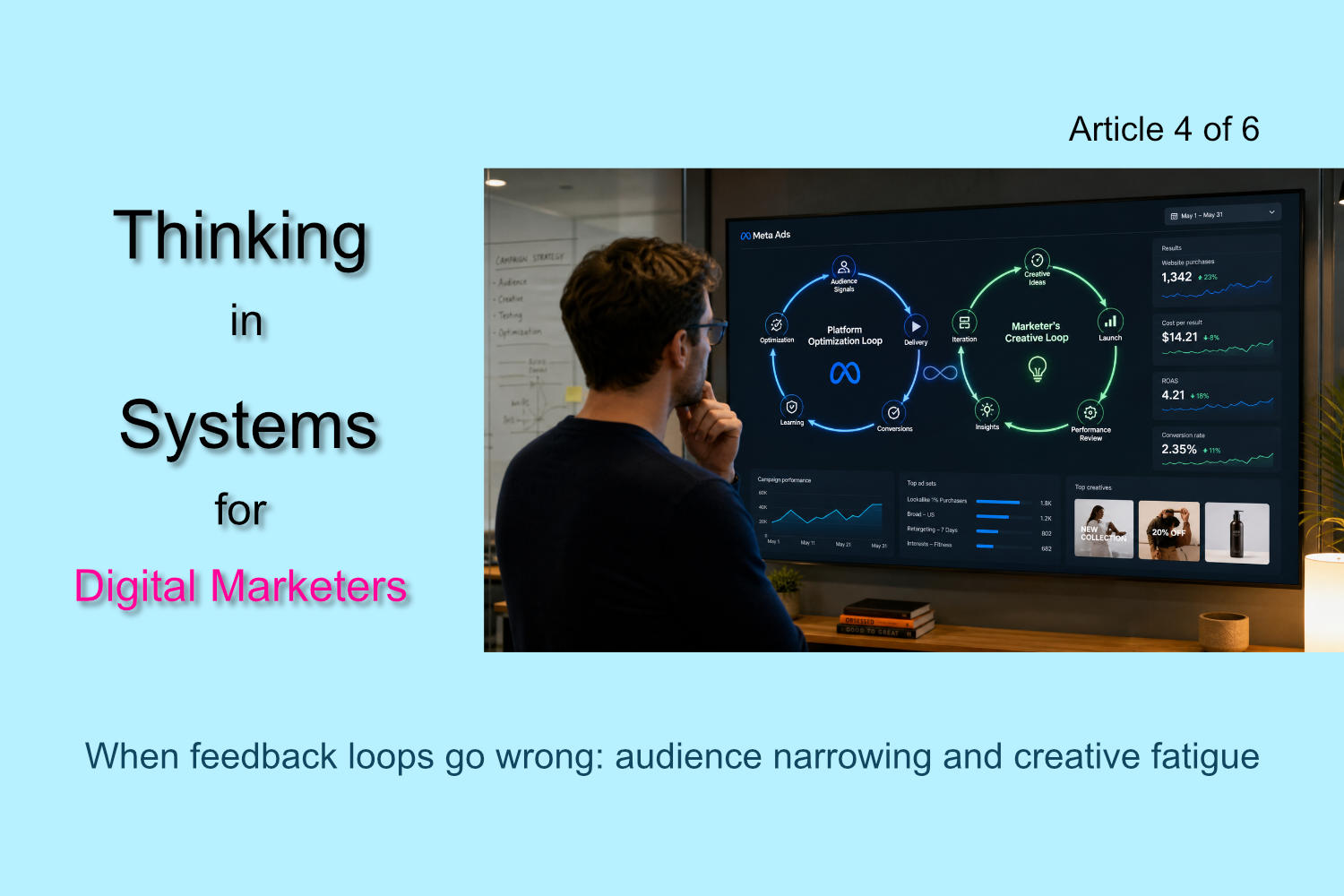
Series: Thinking in Systems for Digital Marketers | Article 4 of 6
This series applies the core concepts of Donella Meadows’ Thinking in Systems: A Primer to the realities of digital marketing. Each article draws directly from the book and translates its frameworks into practical tools for mid-level marketers. If you’re just joining us, we recommend starting with Article 1.
“A feedback loop is a closed chain of causal connections from a stock, through a set of decisions or rules or physical laws, and back again through a flow to change the stock.” — Donella Meadows, Thinking in Systems
You’ve been there. A Meta campaign launches strong — strong CTR, healthy CPMs, conversions coming in at target cost. Then, somewhere around day ten, something shifts. Delivery starts to slow. CPMs creep up. The cost per result climbs past the threshold. You check the creative — it looks fine. You check the audience — nothing obvious. You increase the budget, hoping to push through. The performance dips further.
The wrong instinct is to intervene: pause the ad set, duplicate the campaign, reset everything and start again. But what you’re actually doing when you intervene is interrupting a feedback loop that was in the middle of working — and forcing the system to start over from zero.
The Meta algorithm is not a tool you operate. It is a system you participate in. And until you understand the feedback loops it runs on, you will keep fighting it at exactly the wrong moments.
What a feedback loop actually is
In Thinking in Systems, Meadows defines a feedback loop with precision:
“A feedback loop exists when changes in a stock affect the flows into or out of that same stock.”
In plain language, a feedback loop is what happens when a system’s output circles back and influences its own input. The system responds to itself. It adjusts based on what it has already done.
This is not a metaphor for how Meta’s algorithm works. It is a literal description of it. Every action your campaign takes — every impression served, every click generated, every conversion recorded — feeds back into the system as information. And that information shapes what the algorithm does next: who it shows your ad to, how aggressively it bids, how broadly or narrowly it searches for new audiences.
Your campaign is not delivering ads. It is running a continuous feedback loop. The distinction matters enormously for how you manage it.
Meadows identifies two types of feedback loops, and both are operating inside your Meta campaigns simultaneously.
The two loops inside every Meta campaign
Balancing feedback loops: the system seeking equilibrium
A balancing feedback loop is one that pushes a system toward a goal — a target state it is trying to maintain or reach.
“Balancing feedback loops are goal-seeking. They oppose whatever direction of change is imposed on them. If you push the system away from its goal, the balancing loop will work to bring it back.”
In Meta Ads, the most important balancing loop is the one governing your cost per result. When you set a campaign objective and a budget, the algorithm sets an implicit goal: find the conversions (or clicks, or views, or leads) that meet your objective at the most efficient cost possible. When your cost per result rises above what the system considers efficient, it adjusts — it shifts delivery, changes who it targets, alters its bidding behavior — to bring the cost back toward equilibrium.
This is why campaign performance often stabilizes after an initial volatile period. The balancing loop is doing its job — the system is finding its equilibrium.
But balancing loops can work against you just as easily as they work for you. If you set a budget that is too low for your target audience’s auction competitiveness, the balancing loop will restrict delivery rather than overspend. If you set a cost cap that is below the market rate for your desired conversion, the system will throttle impressions trying to find conversions at a price that doesn’t exist. The loop is seeking balance — but balance around a goal you may have set incorrectly.
Meadows notes that balancing loops always have a goal embedded in them — and the behavior of the system is only as good as the goal the loop is chasing:
“The nature of a balancing feedback loop is to resist change in the stock. Understanding what goal the loop is trying to achieve is essential to understanding why the system behaves the way it does.”
When your Meta campaign isn’t performing, the first question to ask is not “what’s wrong with the ad?” It is: “what goal is the balancing loop chasing — and is that the right goal?”
Reinforcing feedback loops: the system amplifying itself
The second type of feedback loop is more powerful and more dangerous.
“A reinforcing feedback loop is self-enhancing, leading to exponential growth or to runaway collapse. The more it gets, the more it gets.”
Reinforcing loops are what happen when a system’s output doesn’t just feed back into itself — it amplifies itself. The stronger the signal, the stronger the response, which produces an even stronger signal, which produces an even stronger response.
In Meta Ads, reinforcing loops are everywhere — and they work in both directions.
The positive reinforcing loop: Your ad starts performing well. High engagement signals quality to the algorithm. The algorithm rewards quality ads with better delivery and lower CPMs. Better delivery produces more engagement and more conversions. Those conversions feed back as high-quality signals. The algorithm expands delivery further. Performance improves. The loop reinforces itself — this is what a scaling campaign feels like when it’s working.
The negative reinforcing loop: Your ad starts underperforming. Low engagement signals low relevance to the algorithm. The algorithm restricts delivery and raises CPMs. Higher CPMs reduce the budget’s reach. Less reach produces fewer opportunities for conversion. Fewer conversions weaken the signal further. The algorithm pulls back more. This is what a dying campaign feels like — and it feels sudden, even though the loop has been running for days.
This is why Meta campaigns can feel like they tip rather than decline gradually. Reinforcing loops don’t produce linear change. They produce acceleration in whichever direction the loop is already moving.
The learning phase is a feedback loop in its infancy
One of the most misunderstood moments in any Meta campaign is the learning phase — the period, typically the first 50 conversion events, during which the algorithm is calibrating its delivery.
Meadows would recognize this immediately as a feedback loop finding its equilibrium:
“When a feedback loop is first established, the system has no reference point yet. It must gather information — through trial and error — before it can optimize its behavior.”
During the learning phase, Meta’s algorithm is testing delivery across audiences, placements, and times of day. Each conversion event it records feeds back as information: this person converted — what do they have in common with the last person who converted? The algorithm narrows and refines its delivery model with each data point.
This is why disrupting the learning phase is so costly. Every time you make a significant change to a campaign — new creative, budget increase above 20%, audience adjustment — the algorithm resets. The feedback loop loses its accumulated information and has to start learning again from scratch. You haven’t just changed an element. You’ve interrupted the loop’s ability to find equilibrium.
The practical implication is counterintuitive: during the learning phase, the right move is almost always to do less. Let the loop run. Let the system gather information. Intervening feels productive. It is almost always destructive.
When feedback loops go wrong: audience narrowing and creative fatigue
Two of the most common Meta campaign problems are direct consequences of feedback loops running unchecked.
Audience narrowing is a reinforcing loop problem. As the algorithm optimizes toward your best-performing audience segments, it narrows delivery to the people most likely to convert based on historical data. This produces strong short-term results — but the loop reinforces itself into an increasingly small slice of your potential audience. Reach declines. Frequency rises. CPMs increase as you compete harder for the same narrow pool. Eventually the loop has optimized you into a corner.
The solution isn’t to override the algorithm. It’s to introduce new inflow — fresh creative that signals to the algorithm that a broader audience is relevant, or a new campaign objective that deliberately targets the top of the funnel to expand the signal pool the loop is learning from.
Creative fatigue is a balancing loop failing to find equilibrium. When your creative has exhausted its audience — when the people most likely to respond have already responded — the balancing loop can no longer find efficient conversions. CPMs rise, CTR falls, cost per result climbs. The system is not broken. It has simply reached the limit of what this creative can deliver to this audience.
The intervention here is clear: new creative resets the inflow signal. But the timing matters. Meadows would caution against reacting too early — changing creative while the balancing loop is still finding its equilibrium disrupts the process. The skill is reading whether you’re seeing fatigue or seeing the learning phase — and they can look identical in the early days of a campaign.
How to work with the loops, not against them
Understanding that Meta’s algorithm runs on feedback loops produces a different set of operating principles than most marketers use.
Protect the learning phase. Treat the first 50 conversions as sacred. Avoid changes to budget (beyond the 20% rule), creative, audience, and optimization events during this period. The loop needs time and data to find its equilibrium. Interrupting it resets the clock and wastes the signal already accumulated.
Read CPM trends as loop diagnostics. Rising CPMs are not random. They are a signal that the balancing loop is struggling to find efficient delivery — either because the audience is narrowing, the creative is fatiguing, or the cost target is misaligned with market conditions. Falling CPMs with stable or improving conversion rates signal a reinforcing loop working in your favor. Track CPM trends as a leading indicator, not a lagging one.
Use campaign budget optimization to let balancing loops distribute efficiently. When you set budgets at the ad set level, you’re manually overriding the balancing loop that would otherwise distribute budget toward the best-performing delivery. Campaign budget optimization (CBO) lets the algorithm’s balancing loop do what it’s designed to do — find the most efficient allocation across ad sets in real time. For campaigns with multiple ad sets, CBO is not a convenience feature. It’s choosing to trust the loop.
Scale gradually to avoid disrupting reinforcing loops. When a campaign is performing well, the reinforcing loop is your ally. But aggressive budget increases can outpace the loop’s ability to maintain efficiency — the algorithm suddenly has more budget than its current audience model can spend efficiently, and CPMs spike while performance drops. The standard guidance — increase budget by no more than 20% every 48–72 hours — exists precisely to let the reinforcing loop absorb the change without losing its equilibrium.
Introduce new creative before fatigue sets in, not after. Creative fatigue is a lagging signal. By the time frequency is high enough to confirm fatigue, the negative reinforcing loop is already running. Monitor frequency and CTR trends weekly. Introduce new creative when CTR begins declining — not when it has collapsed. Feed the loop before it needs resuscitation.
The deeper lesson Meadows is teaching
Meadows wrote about feedback loops in the context of ecosystems, economies, and global systems — but her underlying point applies just as directly to a Meta Ads account:
“Everything we know about the world tells us that systems with good information-feedback loops are more stable, more adaptive, and more resilient than those without.”
Your Meta campaign is only as intelligent as the feedback it receives. Clean conversion signals, stable campaign structures, and patient optimization windows are not best practices invented by platform guidelines. They are the conditions under which feedback loops can actually do their job — gather real information, adjust behavior based on that information, and converge toward genuine efficiency.
When you interrupt the loop, you don’t improve the system. You rob it of its ability to learn.
The marketers who consistently outperform on Meta are not the ones who intervene the most skillfully. They are the ones who build the conditions for good feedback — and then get out of the way.
Next in the series: Article 5 — Why your marketing keeps surprising you: and what systems theory says about that
This series is based on Donella Meadows’ book Thinking in Systems: A Primer (Chelsea Green Publishing, 2008), interpreted through a digital marketing lens.
