
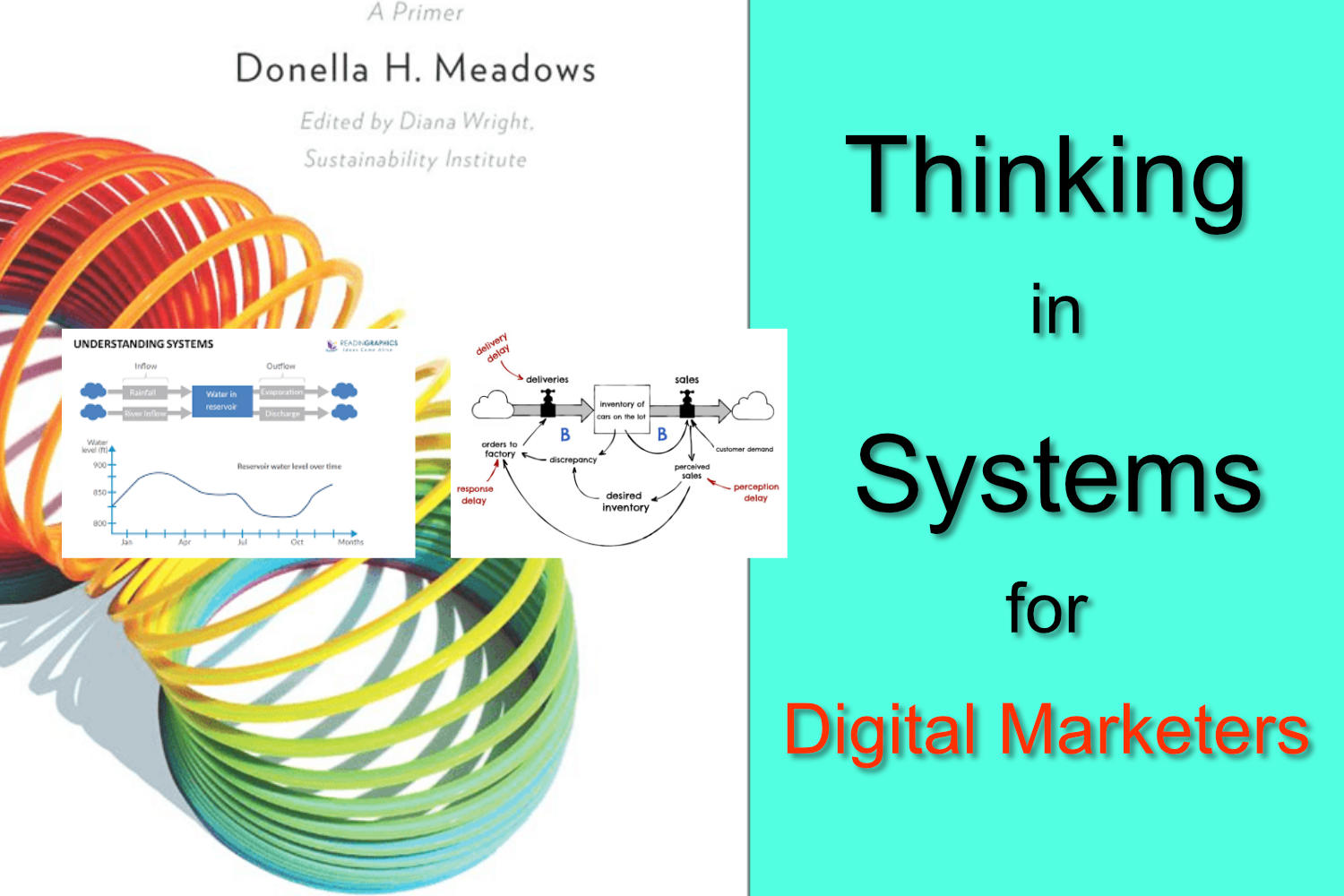
Series: Thinking in Systems for Digital Marketers | Article 1 of 6
About this series
In 1972, a team of MIT researchers published The Limits to Growth — a landmark study warning that unchecked industrial and population growth would eventually collide with the planet’s finite resources. One of the lead researchers on that project was a young scientist named Donella Meadows.
Meadows spent the following decades refining a way of seeing the world that she believed most people were missing: the ability to understand not just individual events, but the underlying structures that produce those events over and over again. Before her death in 2001, she distilled that lifetime of thinking into a single book — Thinking in Systems: A Primer (Chelsea Green Publishing, 2008), published posthumously and now considered one of the essential texts in systems thinking.
The book has found readers far beyond its academic origins — in public policy, medicine, environmental science, and business. But it has been surprisingly underexplored in marketing, which is remarkable, because marketers operate inside complex systems every single day: platforms with their own logic, algorithms with their own incentives, audiences with their own behavior patterns — all interacting in ways that are rarely obvious and almost never linear.
This series is built on a simple premise: what happens when a mid-level digital marketer reads Thinking in Systems seriously? Not as a theoretical exercise, but as a practical framework for understanding why campaigns behave the way they do — and what to do about it.
Over 6 articles, we’ll move through the book’s core concepts and translate each one into the language of digital marketing and campaigns. Every article draws directly from Meadows’ text — her frameworks, her examples, her words — and applies them to the realities of running paid media, managing funnels, and making sense of platform behavior.
You don’t need to have read the book to follow this series. But if you have, we think you’ll see your campaigns very differently by the end.
Let’s start at the beginning — with the most fundamental question the book asks: what is a system, and why does it matter that your campaigns are one?
“A system is a set of things interconnected in such a way that they produce their own pattern of behavior over time.” — Donella Meadows, Thinking in Systems
You’ve been there. A campaign launches, the creative is sharp, the targeting is tight, the budget is healthy — and it still underperforms. You tweak the headline. You A/B test the image. You adjust the bid strategy. Nothing moves the needle.
The problem isn’t what you changed. The problem is what you didn’t see.
Most marketers are trained to think in parts: this ad, that audience, this landing page, that conversion rate. But your campaign doesn’t work in parts. It works as a whole — as a system — and until you see it that way, you’ll keep optimizing the wrong things.
What a system actually is
In her foundational book Thinking in Systems, Donella Meadows — one of the most influential systems thinkers of the 20th century — gives us a deceptively simple definition:
“A system must consist of three kinds of things: elements, interconnections, and a function or purpose.”
Three things. That’s it. But unpacking those three things will permanently change how you look at your marketing.
The three parts of every campaign — and the one you’re probably ignoring
1. Elements: what you can see
Elements are the visible, tangible components of your system. In a digital marketing campaign, your elements are easy to name: the ad creative, the copy, the audience segment, the landing page, the CTA, the budget, the platform.
These are the things marketers spend most of their time optimizing. And that makes sense — elements are visible, measurable, and easy to change.
But here’s Meadows’ warning:
“Changing elements usually has the least effect on the system.”
Read that again. The things you spend most of your time on — swapping headlines, refreshing creative, adjusting targeting — have the least impact on how your campaign fundamentally behaves. Why? Because elements are just the surface. They’re the players on the field. What actually drives the game is something deeper.
2. Interconnections: what you can’t see (but what actually drives results)
Interconnections are the relationships between elements — the rules, flows, and signals that connect one part of your system to another.
In a Facebook or Google campaign, interconnections include:
- How your CTR signals quality score to the algorithm
- How your landing page bounce rate feeds back into your ad delivery
- How your audience’s behavior data shapes who the platform shows your ad to next
- How your conversion data trains the bidding model over time
These aren’t things you set up once and forget. They’re active, dynamic relationships that are constantly influencing each other. Your ad doesn’t just reach an audience — it teaches the algorithm what kind of audience to find next. That feedback relationship is an interconnection.
Meadows notes that many interconnections operate through information flows — signals that tell one part of a system what another part is doing. In digital marketing, data is the interconnection. Every click, scroll, purchase, and exit is a signal flowing through your system, shaping its next move.
Most marketers acknowledge this intellectually but don’t operate accordingly. They change the creative (element) without asking: what signal is this sending to the algorithm (interconnection)?
3. Purpose: what the system is actually trying to do
This is where it gets uncomfortable.
Meadows makes a sharp distinction between a system’s stated purpose and its actual purpose:
“The best way to deduce the system’s purpose is to watch for a while to see how the system behaves.”
Your campaign has a stated purpose: drive conversions, generate leads, grow revenue. But what is it actually doing?
If your campaign is optimized for clicks, its actual purpose is to generate clicks — even if those clicks never convert. If your campaign is optimized for reach, its actual purpose is exposure — even if that exposure never builds meaningful brand equity. If your algorithm is rewarding engagement, your campaign will serve content that gets reactions — even if those reactions come from people who would never buy from you.
The system does what it’s designed to do. The question is whether it’s designed to do what you actually want.
The basketball team test
Meadows uses a brilliant illustration to show why interconnections matter more than elements:
“If you change all the players on a basketball team, you still have a basketball team. But if you change the rules of the game — say, that the team with the fewest points wins — you have something fundamentally different.”
Apply this to your campaigns. You could replace every piece of creative, refresh every audience, rewrite every headline — and if the underlying rules (the algorithm’s incentives, the bidding strategy, the optimization event) stay the same, the system will produce roughly the same results.
But change the optimization event from “link clicks” to “purchase value.” Change the bidding strategy from manual CPC to target ROAS. Change the campaign structure so the algorithm has broader data to learn from. Now you’ve changed the rules — and the system behaves differently.
This is why platform updates hit so hard. When Apple’s ATT changes how data flows between apps, or when Google shifts its matching behavior, the elements of your campaign haven’t changed at all. But the interconnections have — and suddenly your results look nothing like they did before.
What this means for how you work
Once you see your campaign as a system — elements, interconnections, and purpose working together — three things change immediately.
You stop blaming single elements for system-wide problems. Low conversion rate isn’t just a landing page problem. It’s a signal about the entire journey: who the system is attracting, what they expect, and what your page delivers. The landing page is one element in a chain of interconnections.
You start asking, “What is this signal teaching the system?” Every campaign action is also a training action. Pausing an ad, adjusting a bid, changing an audience — each move sends information through the interconnections. Good systems thinkers ask: what behavior am I reinforcing?
You get serious about stated vs. actual purpose. Sit down with your campaign dashboard and ask honestly: what is this campaign actually optimizing for? Not what the brief says — what does the data say it’s rewarding? That gap between stated and actual purpose is where wasted budget lives.
Before the next campaign brief hits your desk
The next time you’re about to launch a campaign, don’t just fill in the usual fields. Ask three questions:
- What are my elements? List the tangible components. Now remind yourself: these are the least powerful levers.
- What are my interconnections? Map how your actions send signals through the platform. How does each element influence the next? What is the algorithm learning from your campaign right now?
- What is my system’s actual purpose? Look at what the algorithm is optimizing for. Does that match the business outcome you actually need?
Meadows opens Thinking in Systems with a quiet but devastating observation:
“The world is a complex, interconnected, finite, ecological — social — psychological — economic system. We treat it as if it were not.”
Your campaigns are a small but real version of that world. Complex. Interconnected. Full of feedback you didn’t design but are subject to anyway.
The marketers who understand this don’t just run better campaigns. They ask better questions. And in a world where everyone has access to the same platforms, the same tools, and the same audiences, the quality of your questions is the only sustainable edge you have.
Next in the series: Article 2 — Why changing your ad creative isn’t enough: the rules of the game are what matter
This series is based on Donella Meadows’ book Thinking in Systems: A Primer (Chelsea Green Publishing, 2008), interpreted through a digital marketing lens.
