
There is a moment every small business owner knows all too well. You have crafted the perfect product. You have polished your website until it gleams. You launch your campaign, expecting a flood of engagement, and instead… silence.
In the noisy bazaar of the digital age, the currency isn’t just money; it’s attention. And according to recent data, you have less time to capture that attention than it takes to read this sentence.
Enter Jenny Hoyos. She isn’t a Fortune 500 CEO or a traditional ad executive. She is a viral hitmaker who cracked the code of the “attention economy” by analyzing thousands of videos. In her recent TED Talk, “The Secret to Telling a Great Story — in Less Than 60 Seconds,” she lays out a framework that is deceptively simple but academically profound.
While her advice targets social media creators, a deep analysis of her content reveals a strategic blueprint that every small business—from local bakeries to B2B consultancies—needs to survive.
The Deep Analysis: Deconstructing the Viral Framework
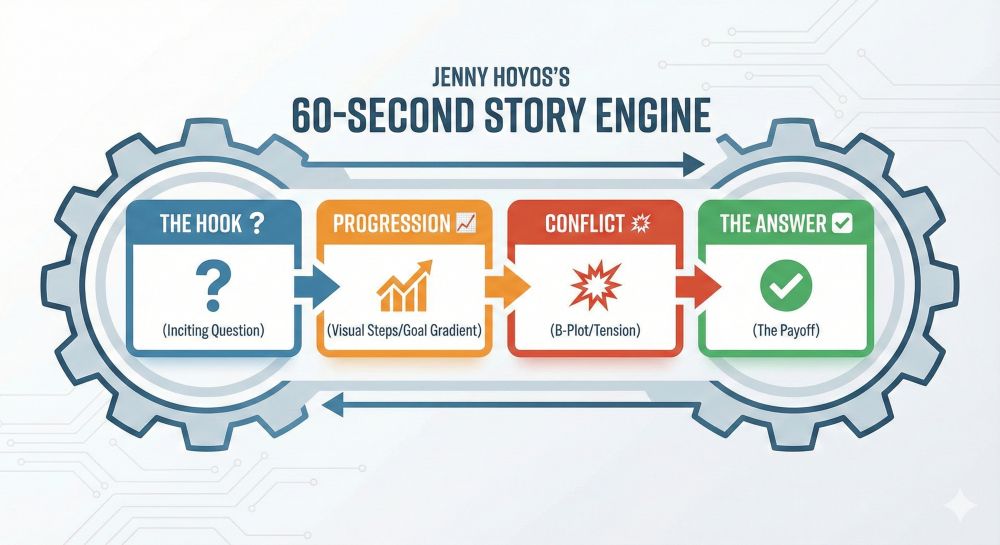
Hoyos’s talk is not just about “being funny” on camera; it is a masterclass in Narrative Efficiency. She dismantles the traditional storytelling arc (often known as Freytag’s Pyramid) and recompresses it for the modern brain.
Here is the academic breakdown of her methodology:
1. The Immediate Hook (The Inciting Incident)
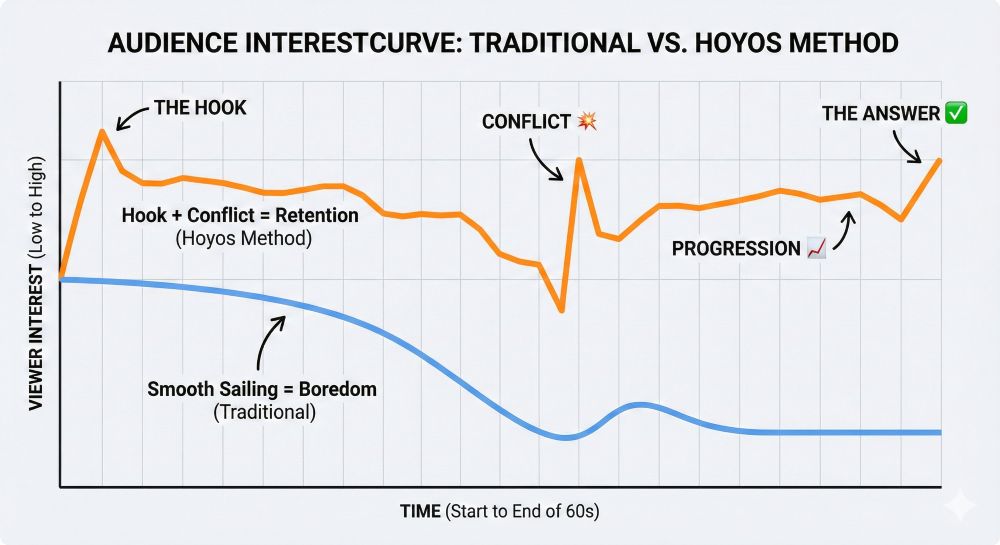
Traditional marketing often starts with an introduction: “Hello, we are XYZ Company, founded in …” Hoyos argues this is fatal. Her framework demands starting with a Question or a Shock.
- The Psychology: This leverages the Information Gap Theory. By asking a burning question (e.g., “Is fast food actually fast?”), She creates a psychological itch that the viewer must scratch by watching the video.
2. Visual Progression (The Goal Gradient Effect)
One of the most profound insights in her video is the need for “constant progression.” In her burger experiment, she didn’t just drive to the restaurant; she verbally and visually ticked off ingredients (lettuce, tomato, cheese).
- The Psychology: This taps into the Goal Gradient Effect, a behaviorist concept suggesting that humans work harder and stay more engaged the closer they feel to a goal. If your audience feels they are stagnant, they leave.
3. Conflict as a Retention Tool (The B-Plot)
A smooth story is a boring story. Hoyos introduced a “B-Plot” involving her mother’s chaotic driving.
- The Analysis: In narrative theory, this creates texture. It shifts the content from a dry scientific test to an emotional human experience. It creates stakes—not just “will she get the burger?” but “will they survive the drive?”
4. The Concise Answer (The Payoff)
She ends with a definitive answer. No cliffhangers, no “part 2.” She closes the loop she opened in the first second.
From Viral Video to Business Strategy: How Small Businesses Can Apply This
So, how does a 60-second burger challenge help you sell software, coffee, or consulting services? The principles are identical. Here is how small businesses can make the most of Hoyos’s framework.
1. Kill Your “About Us” Intro
Most small businesses waste their most valuable real estate—the top of their website or the first 10 seconds of a sales pitch—talking about themselves.
- The Fix: Start with the Customer’s Problem (The Hook). Instead of saying, “We have 10 years of experience in plumbing,” say, “Why do pipes always burst on Sunday nights?” You have immediately aligned with their pain point.
2. Gamify the Customer Journey (Progression)
Hoyos kept viewers watching by showing them how close they were to the finished burger. Small businesses often leave clients in the dark during long processes.
- The Fix: Whether you are designing a logo or building a house, create a visual roadmap for your client. Show them the “ingredients” coming together. Send updates that say, “Phase 2 of 4 complete.” The feeling of progression builds trust and reduces buyer’s remorse.
3. Embrace the “Conflict” in Your Marketing
Many brands try to appear flawless. They scrub their case studies of any struggle. But clients don’t trust perfection; they trust overcoming adversity.
- The Fix: When writing case studies or testimonials, don’t just show the result. Show the mess. Talk about the budget crisis that happened halfway through the project and how you solved it. This “B-Plot” proves your competence more than a perfect track record ever could.
4. The “One-Minute Pitch.”
Hoyos delivered her talk in four minutes instead of five. In business, brevity is a signal of authority.
- The Fix: Audit your sales deck. Can you explain your value proposition in less than 60 seconds? If you can’t, you don’t understand your product well enough yet. Force yourself to strip away the jargon until only the “Answer” remains.
The Bottom Line
Jenny Hoyos’s video teaches us that in 2025, attention is not given; it is earned, second by second.
For the small business owner, the lesson is clear: Stop broadcasting and start storytelling. You don’t need a million views to succeed, but you do need to respect your customers’ time. Hook them with a question, guide them through the progress, acknowledge the struggle, and deliver on your promise.
Sometimes, the secret to a great business, like a great story, is simply knowing when to cut to the chase.
