
In the spring of 2019, two businesses stood at the edge of two very different marketing worlds.
One was a boutique furniture brand in Downtown Dubai, proudly hanging banners along Sheikh Zayed Road. The other, a family-run remodeling firm tucked into the suburbs of Northern Virginia, paid monthly for a quarter-page ad in a regional paper that hadn’t changed its font since the Clinton administration.
Both businesses were doing “what worked.”
At least, what used to work.
Then something started to shift—quietly, invisibly, but undeniably.
Not with a bang. Not with an announcement.
But with a blog post.
A podcast episode.
A downloadable guide titled “5 Ways to Rethink Your Living Room.”
This wasn’t a marketing trend. It was a migration.
The Migration from Classic to Inbound
A few months ago, we published an article titled From Billboards to Bots: Inbound Marketing in the Age of AI. It explored the philosophical and practical distinctions between Classic Marketing (billboards, radio, direct mail) and Inbound Marketing (content, SEO, lead funnels).
At the time, our arguments were largely observational, rooted in industry behavior, strategic preference, and anecdotal ROI.
Today, we bring numbers to the table.
Real ones.
Five years’ worth.
Across two markets that rarely sit side by side in a study: Dubai and Northern Virginia.
Why these two? Because Dubai represents rapid infrastructure and advertising evolution in the GCC, while Northern Virginia captures suburban America’s cautious but consistent pivot toward digital strategies.
They don’t look alike on a map. But their marketing timelines? Uncannily parallel.
Dubai: Where the Billboards Once Ruled
In 2019, digital advertising in MENA was worth around $5.5 billion. Five years later, that figure surged to $25.5 billion—an increase that’s not just statistical, but cultural.
Where once brands fought for visual real estate along Dubai Marina, they’re now vying for keyword placement and Google SERPs.
Traditional advertising? Still visible. Still valued. But its dominance is fading. According to Campaign Middle East, the overall ad spend in the region rose modestly year over year—4.2% in 2024—but the digital share skyrocketed.
It’s not just that people moved online. It’s what ROI did.
Inbound campaigns, SEO-driven blogs, targeted email flows, and video tutorials began outpacing traditional placements not just in reach, but in return.
Northern Virginia: Suburban America Rewires Its Funnel
The shift here was quieter, more polite, less tectonic, more tectonic-plate-slow. But it happened.
In 2019, many small businesses in Fairfax and Alexandria still leaned on yard signs, coupon magazines, and word-of-mouth.
But by 2021, these same businesses were running keyword-optimized blogs, tracking click-through rates on Mailchimp, and A/B testing Facebook lead ads.
Local agencies like 99MediaLab and Hunter Digital didn’t just suggest the change—they built their entire business models around inbound strategies.
One Fairfax-based remodeling firm, for example, went from spending 80% of its marketing budget on flyers and seasonal home expos… to devoting 90% of it to content, paid search, and automation by 2024.
What the Data Says
Over the past five years, the numbers tell a striking story—no spreadsheets required:
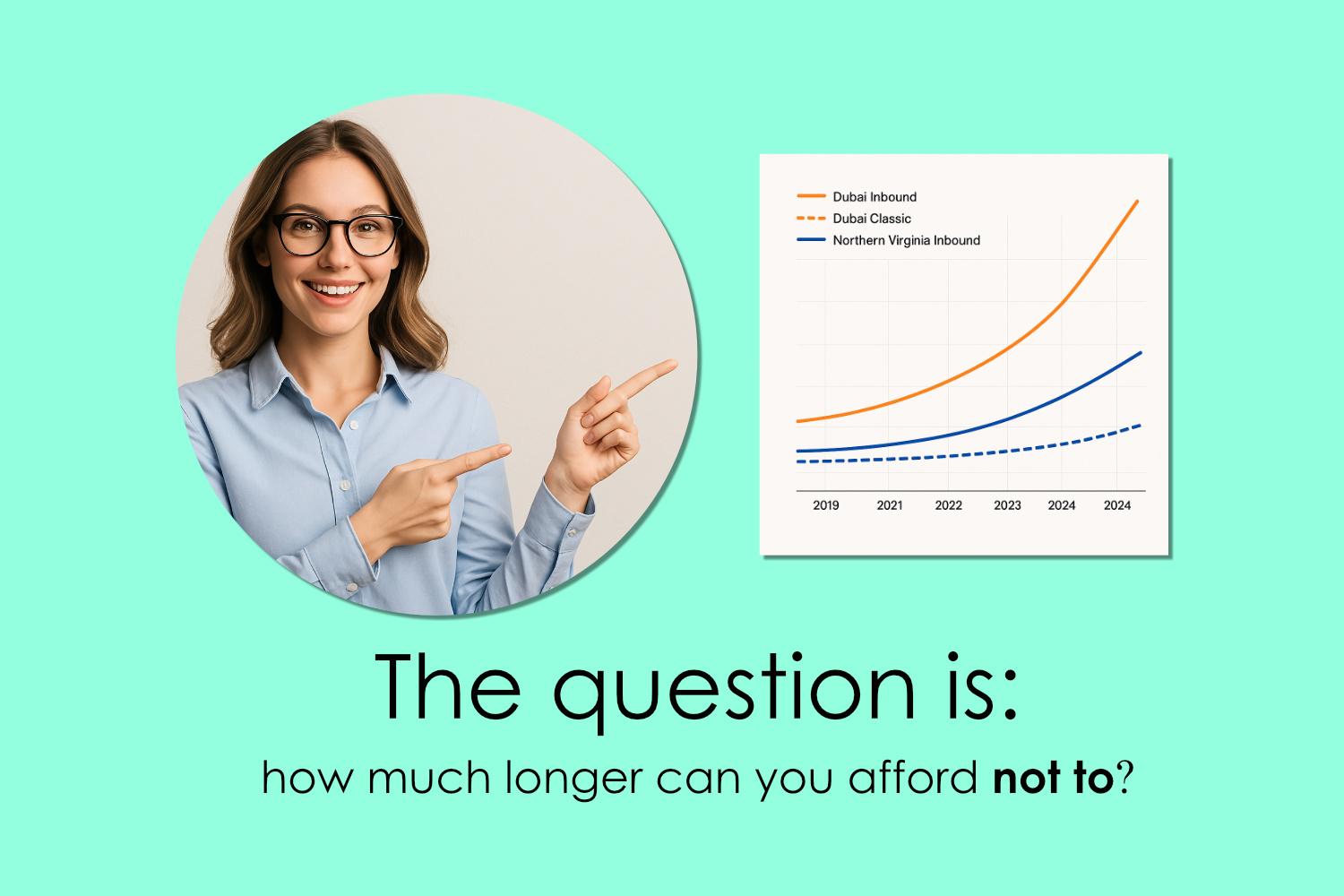
- In Dubai, spending on inbound marketing has tripled to quadrupled since 2019, while traditional advertising budgets have stayed nearly flat.
- In Northern Virginia, digital inbound strategies have grown by over 200%, with classic marketing increasing only 10–15%, mostly due to inflation or seasonal campaigns.
- Businesses that transitioned to inbound report a 30–40% drop in cost per lead compared to five years ago.
- ROI from inbound marketing has more than doubled in both markets, now delivering 2.5–3× returns for every dollar spent—far outpacing classic marketing, which lingers around 1.2–1.3×.
- Perhaps most importantly: the quality of leads from inbound sources is consistently rated higher, more relevant, more ready, and more likely to convert.
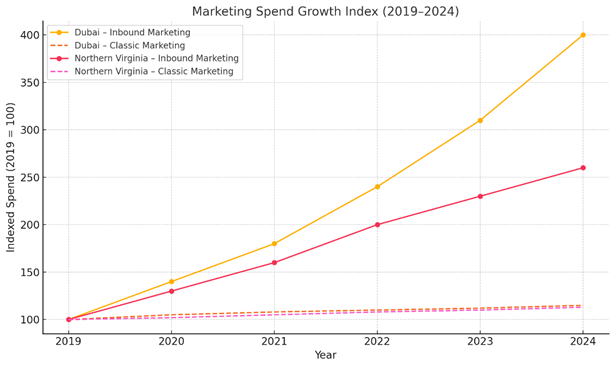
Dubai’s inbound marketing spend has skyrocketed—4× growth.
Northern Virginia also shows solid inbound growth—2.6× over five years.
Classic marketing in both regions grew only slightly—just 10–15% overall.
In short, inbound didn’t just grow. It outperformed, outlasted, and outsmarted classic marketing at nearly every metric.
The Invisible Cost of Staying Traditional
There’s a story told in both cities—not by ad agencies or marketers—but by budgets.
When inbound marketing is ignored, it’s not just an opportunity missed. It’s a cost incurred. A lost efficiency, a weaker lead, a higher customer acquisition cost.
What was once a competitive edge has become a survival requirement.
It’s not that billboards don’t work. They do—if you’re Coca-Cola.
It’s not that flyers are dead. They aren’t—if you’re targeting foot traffic within a 2-block radius.
But for brands seeking scale, targeting, and adaptability? The story has changed.
Inbound isn’t a tactic.
It’s the infrastructure now.
Closing Thought: Why This Matters More Than Ever
We’re in a moment where AI can write your content, segment your lists, and predict your next lead.
But tools aren’t the point. Strategy is.
And the strategy that survived 2020, grew in 2022, and dominated 2024 is inbound.
From Dubai to Northern Virginia, the data isn’t subtle. It’s screaming.
So the question isn’t whether you should switch.
The question is: how much longer can you afford not to?
