
There’s a small moment most advertisers skip.
It lasts maybe thirty seconds.
And skipping it costs thousands.
They open Google Ads first.
They trust the interface. They trust AI. They trust that the structure can be fixed later.
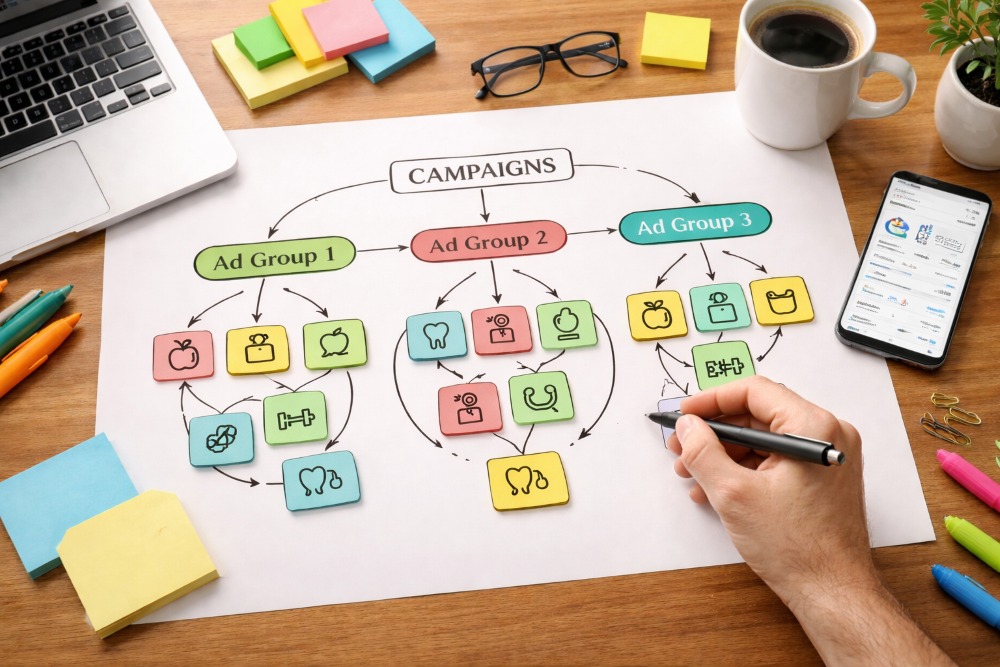
It can’t. Not really. The strongest accounts don’t begin with keywords or automation. They begin with a pen, a blank page, and an Account Map.
Start Where the Money Behaves Differently
Campaigns are not folders. They are financial decisions.
Before you think about ads or keywords, ask one uncomfortable question:
Where do I want my money to act differently?
- Immediate sales vs long-term awareness
- High-margin offers vs low-margin offers
- Online conversions vs phone calls or visits
If the goal, risk, or budget tolerance changes, it’s not one campaign anymore.
This is the first place many accounts go wrong—not because they lack features, but because they lack intention.
Ad Groups Are Not Categories. They’re Conversations.
Inside each campaign, ad groups are often treated like a product list.
That’s a mistake.
Ad groups are intent containers.
Each one represents a single state of mind.
If one person in that group is thinking something different than another, they don’t belong together.
This is where the map saves you from future confusion.
The Ad Test (The One Test That Never Lies)
Once you draw an ad group, stop. Look at the keywords inside it and ask:
Can I write one honest, specific ad that makes sense for every keyword here?
Not a generic ad.
Not a “technically correct” ad.
An ad someone would actually click.
If the answer is no, the group is lying to you. Split it.
Let’s make that concrete.
Example 1: Organic Juice Shop (Local, Real Intent)
Campaign: Online Orders – Dubai
You sketch one ad group with:
- detox juice delivery
- green juice
- protein smoothie
On paper, it looks efficient. In reality, it’s confused.
A detox search is about cleansing.
A protein search is about energy or fitness.
A green juice search often sits somewhere in between.
Try writing one ad.
If it says:
“Cleanse Your Body with Fresh Detox Juice”
You just lost:
- gym-focused users
- performance-driven buyers
So the map changes:
- Ad Group: Detox Juice (cleansing, reset, short-term goals)
- Ad Group: Green Juice (daily health, balance)
- Ad Group: Protein Smoothies (energy, muscle, recovery)
Same business.
Same kitchen.
Different motivations.
The map respects that.
Example 2: Dental Clinic (Service, High Stakes)
Campaign: New Patient Appointments
You group:
- teeth whitening
- dental implants
- root canal treatment
From a business perspective, they’re all dentistry.
From a human perspective, they are completely different emotions.
Whitening is an aspiration.
Implants are long-term decisions.
Root canals are urgent and painful.
If the ad says:
“Advanced Root Canal Treatment – Book Today”
Whitening searches vanish.
Cosmetic-focused users don’t even slow down.
So the map forces clarity:
- Ad Group: Teeth Whitening (confidence, appearance)
- Ad Group: Dental Implants (trust, expertise, longevity)
- Ad Group: Root Canal (relief, speed, reassurance)
This isn’t over-structuring.
This is alignment.
Where AI Makes This Faster (and Where It Stops)
AI is incredible at speed.
It can:
- Cluster keywords in seconds
- Suggest ad variations instantly
- Propose structures that would take hours manually
But AI doesn’t know your business economics.
It doesn’t feel urgency.
It doesn’t know which lead makes you money and which one drains your team.
AI executes patterns. Experts choose which patterns matter.
The better your account map, the smarter AI becomes—because now it’s operating inside a system that makes sense.
The Quiet Advantage Most Accounts Never Get
When you map first:
- Budgets stop leaking across mixed intent
- Ads become easier to write, not harder
- Optimization becomes directional, not reactive
You’re no longer “fixing” Google Ads.
You’re guiding it.
So before dashboards.
Before automation.
Before AI suggestions.
Pause.
Grab a piece of paper.
That pause isn’t slowing you down.
It’s the moment you decide whether this account will be noisy—or precise.
