
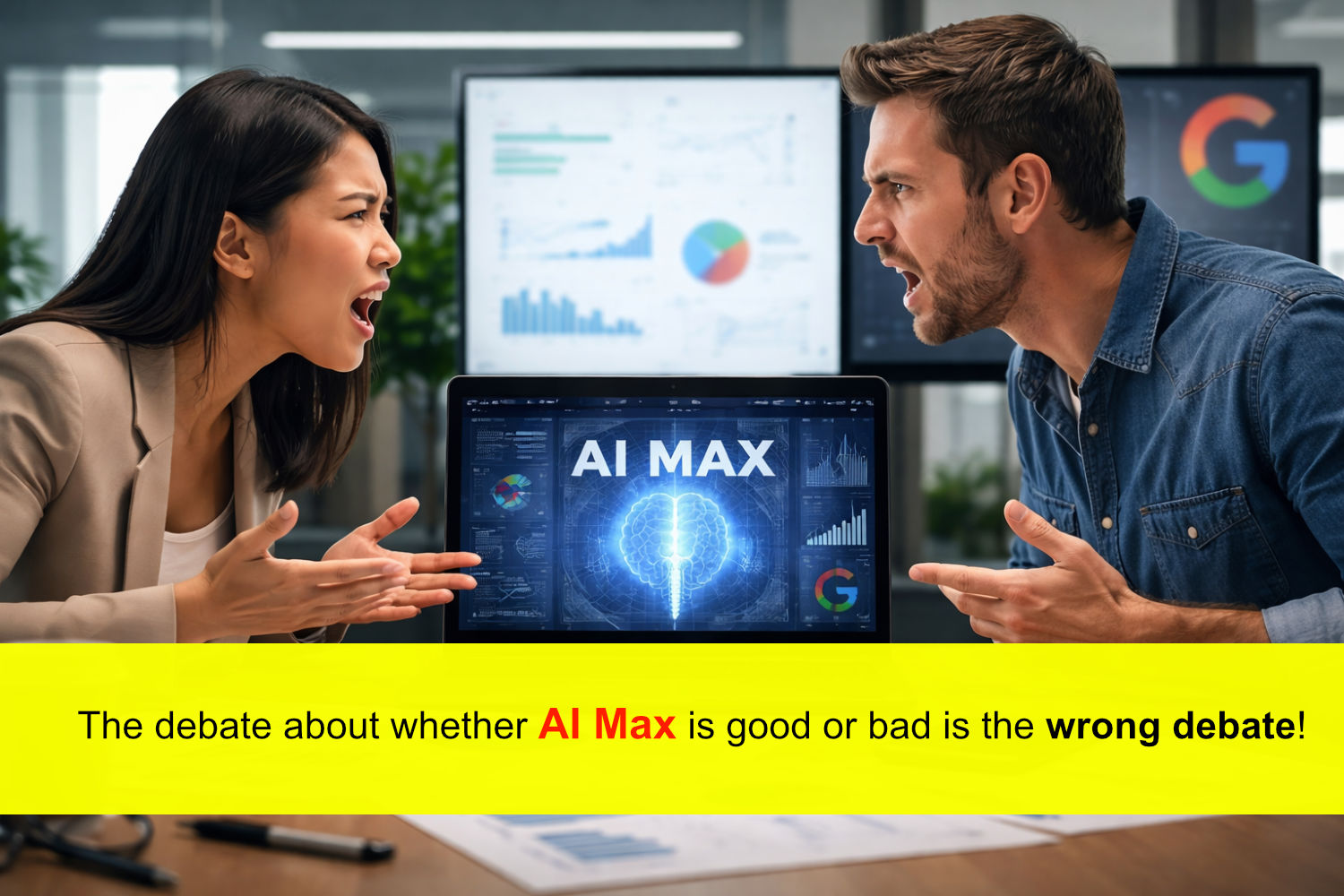
How AI Max Divided the Marketing World Into Believers and Skeptics
In May 2025, during Google Marketing Live, AI Max for Search was introduced.
By early 2026, it had already divided the marketing world.
Within six months, 27% of Google Ads accounts had enabled AI Max. Some reported conversion increases between 14% and 27%. Others saw budgets expand without corresponding business growth.
By February 2026, the split was clear:
Half the industry viewed AI Max as the future of search advertising.
The other half saw it as increased automation with reduced control.
The real question is not whether AI Max is good or bad.
The real question is: under what conditions does it work?
What AI Max Actually Is in Google Ads 2026
AI Max is not a campaign type.
It is an automation layer applied to existing Search campaigns.
When enabled, AI Max:
- Converts keywords to broad match
- Expands targeting using keywordless technology
- Dynamically adjusts ad copy
- Enables final URL expansion
Only some features are mandatory. Others are optional. But together, they significantly shift control from advertiser to algorithm.
According to Google’s 2025 internal data:
- Average accounts saw a 14–19% lift in conversions
- Exact-match-heavy accounts saw up to 27% lift
- Unique query category reach increased by 18%
Those are averages. And averages rarely tell the full story.
Why Some Accounts Thrive with AI Max
High-performing accounts share three common traits:
- Strong monthly conversion volume (30+ minimum, ideally 300+)
- Accurate conversion tracking tied to real business outcomes
- Landing pages already optimized for performance
In these environments, AI Max amplifies what already works.
Automation thrives on clean data.
When signals are strong, expansion becomes an opportunity.
For high-volume ecommerce or SaaS accounts, AI Max often uncovers adjacent search demand that manual keyword research would miss.
In these cases, performance improves without sacrificing efficiency.
Why Other Accounts Struggle
Lower-volume or specialized accounts often experience the opposite.
Common issues include:
- Fewer than 30 conversions per month
- Weak attribution models
- Broad match historically underperforming
- Highly technical or niche products requiring precision
AI Max expands aggressively.
If the foundation is unstable, automation magnifies instability.
Across 2025 industry reports:
- Median CPA increased by 12% across many sectors
- Conversion rates dropped in several verticals
- Some agencies reported up to 15% spend inefficiency
The algorithm optimizes for what it can measure.
If tracking is flawed, optimization will follow flawed signals.
The Context Factor: Why the Industry Split Happened
AI Max did not divide the marketing world because it behaves inconsistently.
It divided the marketing world because accounts are inconsistent.
High-volume, clean-data accounts experienced growth.
Low-volume, imprecise accounts experienced volatility.
Both groups are correct based on their context.
This is the tipping point: Automation rewards readiness.
The Power Pack Strategy in 2026
Google’s recommended structure now emphasizes:
- Performance Max for multi-channel reach
- AI Max for Search expansion
- Demand Gen for upper-funnel activity
Standard manual Search campaigns are no longer positioned as the primary framework.
The strategic shift is clear:
More automation.
More signal-based optimization.
Less manual control.
Whether that benefits a business depends on preparation, not ideology.
The Real Question in Google Ads 2026
Before enabling AI Max, ask:
- Is there sufficient conversion volume?
- Is conversion tracking tied to actual revenue?
- Has broad match been tested successfully?
- Are non-converting URLs excluded?
- Is the account structurally sound?
If the answer to these questions is yes, AI Max may scale performance.
If the answer is no, automation will likely scale inefficiency.
The True Tipping Point
AI Max is not universally transformative.
It is conditionally powerful.
The debate about belief versus skepticism misses the core issue.
Automation does not replace strategy. It amplifies it.
The tipping point is not when Google releases a feature.
The tipping point is when an account is structurally ready for it.
In Google Ads 2026, success is less about control versus automation.
It is about signal quality, structural discipline, and strategic clarity.
Everything else is noise.
