
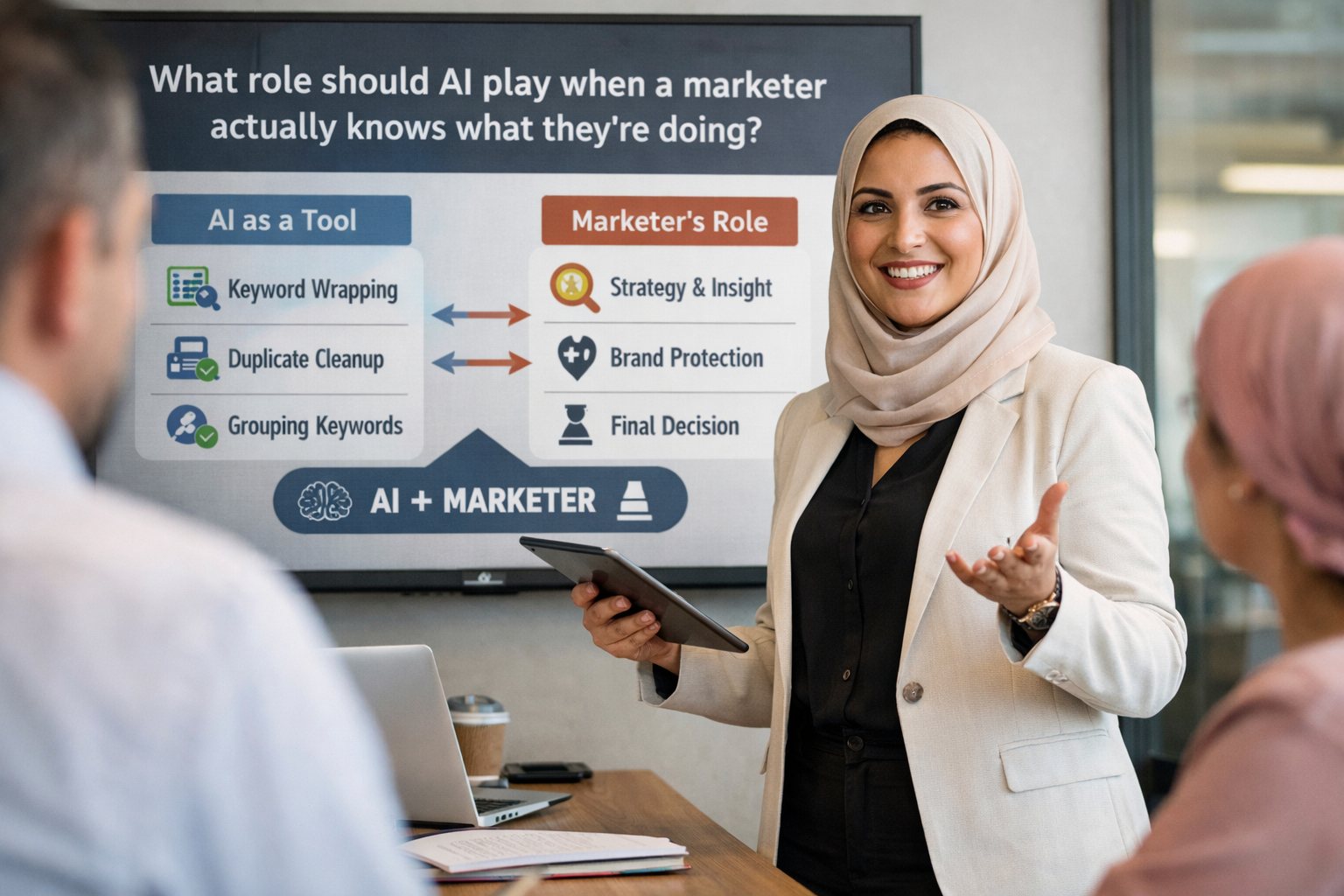
The real question in 2026 isn’t “Can AI replace keyword wrappers?”
It’s “What role should AI play when a marketer actually knows what they’re doing?”
Because here’s the line that matters—and it aligns perfectly with how this blog thinks:
The future isn’t AI replacing marketers. It’s AI amplifying the marketers who know what they’re doing.
Keyword wrappers were built for syntax.
AI is built for intent.
Those are two very different jobs.
What a keyword wrapper really does (and doesn’t)
A traditional wrapper is honest. Almost too honest.
You paste a list.
It adds brackets [ ] and quotes ” “.
No opinions. No context. No brand sense.
For years, that was enough—especially when Google Ads respected strict match boundaries.
But in 2026, the platform doesn’t read keywords the way it used to.
It reads meaning, behavior, and context—inside Google Ads and beyond.
Where AI quietly does more than wrapping
AI can already do everything a wrapper does mechanically—but that’s not the interesting part.
The interesting part is this:
AI doesn’t just see words.
It sees why someone typed them.
If you paste a keyword list into AI and ask it to:
- wrap keywords in Phrase and Exact
- remove duplicates
- group by user intent
…it will do it in seconds.
But unlike a wrapper, it can also tell you:
- Which keywords sound informational vs transactional
- Which ones risk attracting the wrong audience
- Which ones may deserve to be negative keywords
That’s not automation.
That’s expansion
Why wrapping itself is changing in 2026
Google’s ecosystem now prioritizes:
- Smart Broad Match
- Landing page signals
- User behavior patterns
- AI-generated search experiences
In AI-driven search summaries, ads often surface based on conversation relevance, not bracket logic.
That doesn’t mean keywords are dead.
It means keywords became signals, not switches.
And signals still need humans to decide:
- what represents the brand
- what doesn’t
- what should never trigger an ad
A MENA reality, not a Silicon Valley theory
Take a regional example.
A perfume brand in Riyadh targeting oud searches:
- “buy oud perfume”
- “luxury oud gift”
- “best oud for men”
A wrapper will format them.
AI will notice something deeper:
Some queries are about status.
Others are about gifting etiquette.
Others are about religious or cultural usage.
Only a marketer understands which of those aligns with the brand’s positioning—and which could dilute it.
AI helps surface the pattern.
The marketer decides what to do with it.
The real pro move in 2026
Picture two marketers, same account, same market.
The first opens a spreadsheet with 5,000 keywords.
No hesitation. No philosophy.
They run it through a traditional wrapper, copy, paste, move on.
And honestly? That’s the right call. Speed matters sometimes.
The second marketer pauses.
Not because the list is bigger—but because the account is.
A real brand. A real voice. Real consequences if the wrong query slips through.
So instead of just wrapping, they ask AI to look closer:
to clean what doesn’t belong,
to cluster what feels similar but behaves differently,
to challenge intent instead of assuming it,
to flag the keywords that could quietly hurt the brand.
And then—this is the part that separates experience from automation—
the marketer decides.
Not the tool.
Not the platform.
The human.
Because tools execute.
Accountability doesn’t.
Final thought
Yes, AI in 2026 can absolutely do the mechanical job of a keyword wrapper.
But that was never the real job.
The real job is knowing why a keyword belongs,
when it should be allowed to trigger,
and where it could go wrong.
The advantage isn’t choosing AI over control.
It’s using AI to sharpen control.
And that’s why—quietly, consistently—
Skilled marketers are still the ones winning.
